01
Licensing trap: numbers and risks
How Oracle Java licensing rules changed, who may be included in the employee definition, and why it pays to start with an inventory.

The e-book explains how to navigate Oracle Java's new licensing model, when it makes sense to stay with your current setup, and when to consider a supported OpenJDK option such as Azul Platform Core.
A practical view of costs, risks and migration steps. The e-book itself is in Czech.

Oracle Java SE Universal Subscription can change how companies calculate costs. The e-book explains why inventory and budget impact matter first.
Sometimes staying with Oracle makes sense. In other cases, supported OpenJDK is a rational option. The guide helps distinguish both scenarios.
A runtime migration must not put operations at risk. The e-book covers discovery, rollout, validation and a rollback plan for IT Ops.
Get an overview of what Oracle Java licensing changes mean for your budget, operations and long-term IT strategy.
How Oracle Java licensing rules changed, who may be included in the employee definition, and why it pays to start with an inventory.
A pragmatic decision framework: when the current solution is fine and when supported OpenJDK starts to make sense.
What to look for in enterprise deployments: TCK certification, SLA, security patches, multiplatform support and vendor lock-in.
Discovery, rollout and validation in practice, including why a drop-in replacement does not have to mean rewriting applications.
The e-book does not start with technical steps. It first helps identify when migrating from Oracle Java is economically and operationally reasonable, and when staying with the current solution may be the better path.
Helps you verify whether Java represents a licensing risk in your company or simply a normal operating item.
Combines budget impact, support for critical systems and practical migration feasibility.
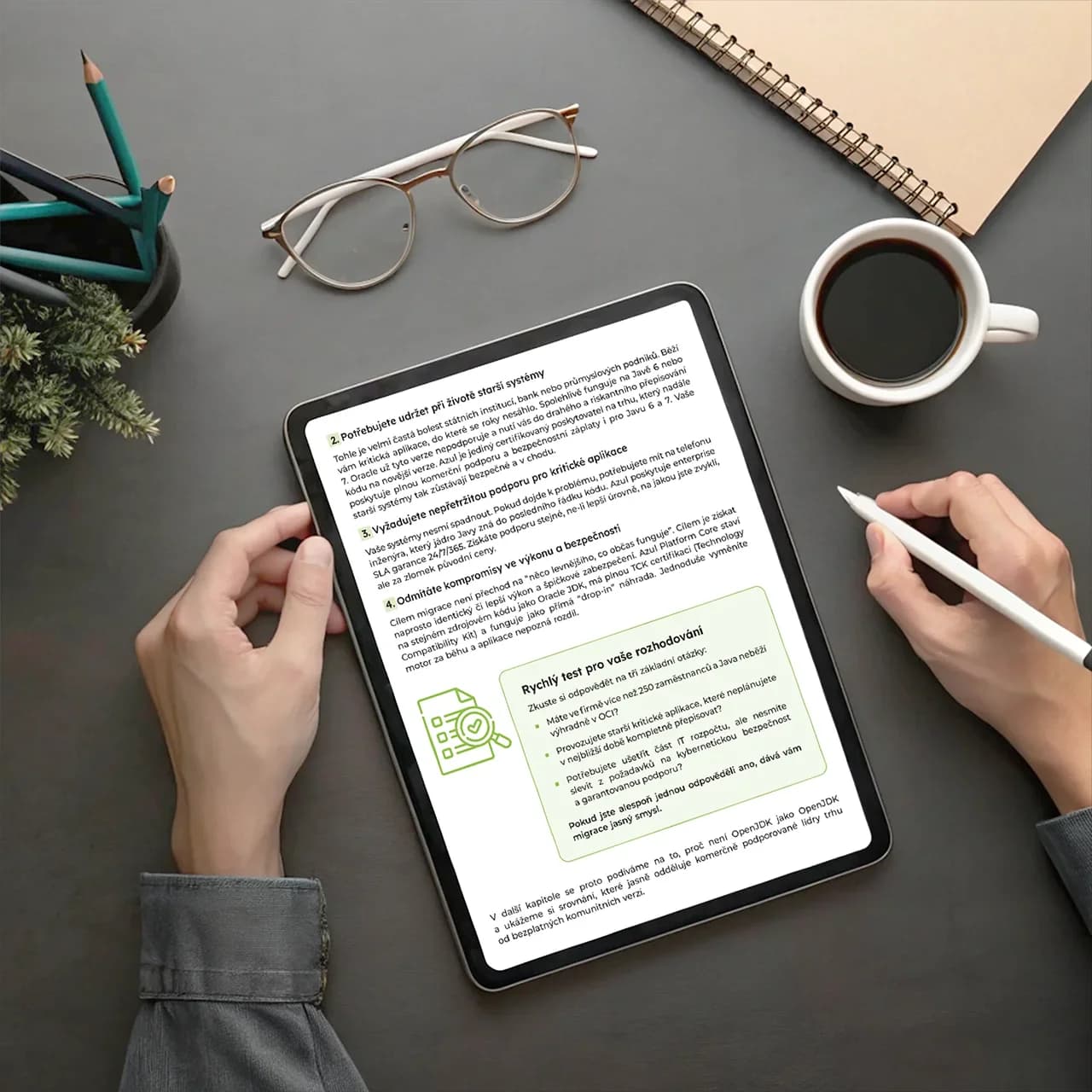
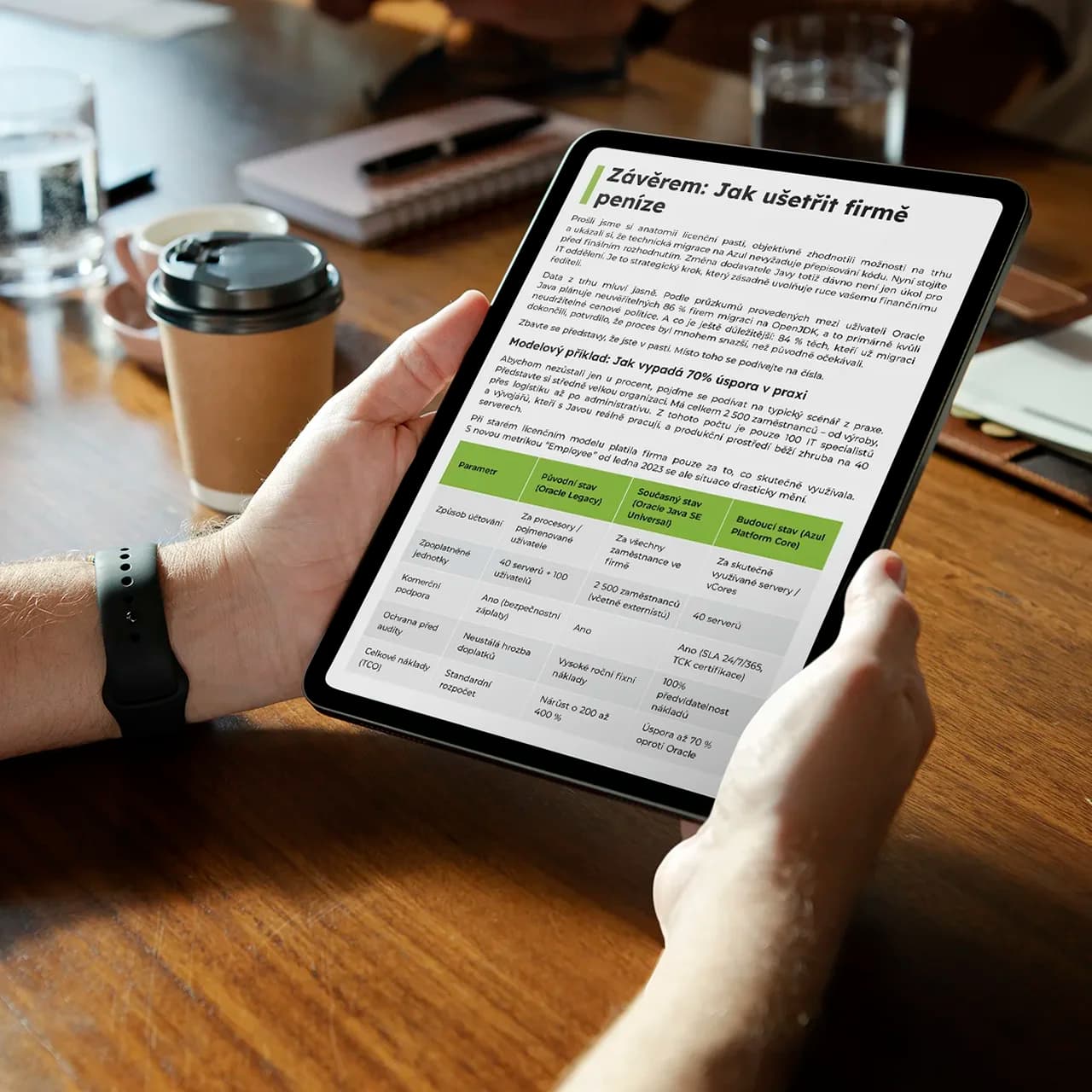
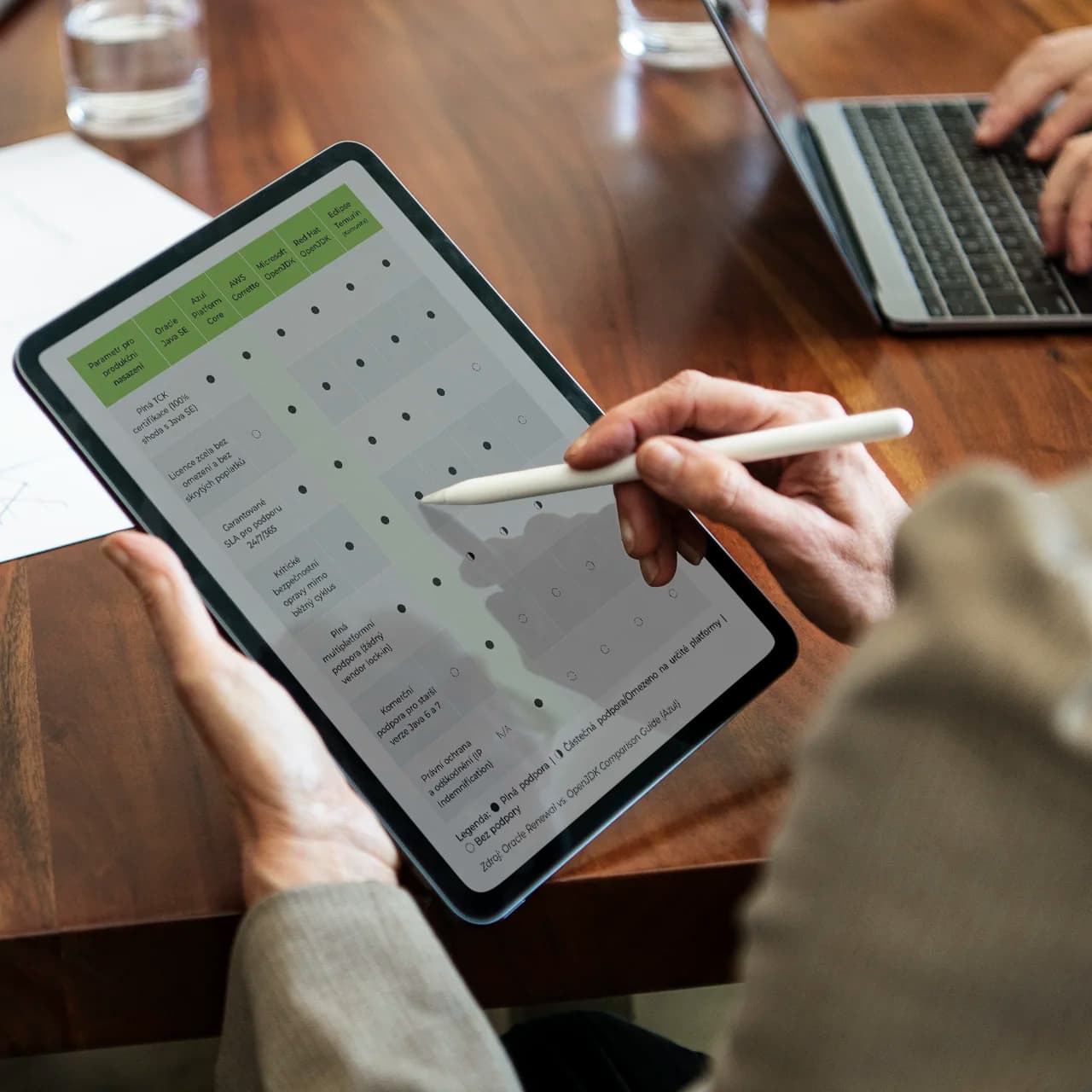
In the practical section, the e-book shows three steps: discovery, rollout and validation. You first identify where Java runs, then prepare the runtime replacement, and finally validate functionality through tests or key users.
Important: The goal is not to promise migration without work. The goal is to show how to do it with a reasonable plan, minimal risk and a clear rollback scenario.
The e-book connects financial, technical and operational views. It is useful for companies dealing with Java costs, support for older systems, or preparation for a licensing audit.
Budgets, cost predictability, audit risk and a realistic estimate of possible savings.
Platform strategy, compatibility, security patches, SLA and limiting vendor lock-in.
Inventory, JAVA_HOME changes, regression tests, deployment packages and a rollback plan.
The e-book is not about pushing immediate migration at any cost. It helps you get visibility, ask the right questions and prepare a qualified decision.
Potential savings compared with Oracle in model scenarios described in the e-book. The real impact depends on infrastructure and licensing situation.
With a drop-in migration, application source code typically does not change. Testing and validation are still required.
Fill in your contact details and download the practical guide to migrating from Oracle Java to a supported OpenJDK solution.
Please note: the e-book is currently available in Czech.
The e-book explains why technical compatibility is key and why a drop-in replacement usually does not require rewriting applications. Real ROI depends on the number of instances, servers and your current licensing model.
The guide describes testing, JAVA_HOME handling and a rollback plan. The point is to migrate in a controlled way, not in one jump without validation.
Yes, support for legacy versions is one of the topics in the e-book. Each application, its dependencies and operational risks still need to be assessed individually.
The first step is discovery: inventory of versions, environments, application owners and links to support contracts. Without it, both costs and risks are hard to estimate.
Download the e-book and walk through the decision questions, option comparison and practical safe migration process.